
Solar panel price in Greater Noida, 1–10 kW
For a Greater Noida home using two or three air conditioners through summer, 3 kW is often the right place to start. It produces about about 338 units a month a month on the planning assumptions used here and typically pays back in four to five years on NPCL’s tariff.
The published price is ₹1,99,000 to ₹2,10,000. After the central and Uttar Pradesh subsidy, the estimated amount is ₹91,000 to ₹1,02,000.
The price is the same as in Noida city, but the process is different: Greater Noida and Greater Noida West are served by NPCL. Use the table below to compare system sizes and the NPCL guidance before you request a quote.
The price table for Greater Noida
| System | Price | Central subsidy | Uttar Pradesh state subsidy | Net payable | Units a month |
|---|---|---|---|---|---|
| 1 kW | ₹70,000 – ₹80,000 | − ₹30,000 | − ₹15,000 | ₹25,000 – ₹35,000 | about 113 |
| 2 kW | ₹1,35,000 – ₹1,50,000 | − ₹60,000 | − ₹30,000 | ₹45,000 – ₹60,000 | about 225 |
| 3 kW | ₹1,99,000 – ₹2,10,000 | − ₹78,000 | − ₹30,000 | ₹91,000 – ₹1,02,000 | about 338 |
| 5 kW | ₹3,25,000 – ₹3,50,000 | − ₹78,000 | − ₹30,000 | ₹2,17,000 – ₹2,42,000 | about 563 |
| 10 kW | On request | − ₹78,000 | − ₹30,000 | Quote-based | about 1,125 |
Indicative prices. Your written quote, after a free site survey, is the final price. Generation uses a planning yield with a 10% derate for dust and monsoon. The UP state top-up is paid on top of the central subsidy; we confirm the current amount in your quote.
Each published price covers panels, inverter, mounting structure, net-metering work, installation and warranty. The central subsidy pays ₹30,000 per kW for the first 2 kW and ₹18,000 for the third, so it reaches ₹78,000 at 3 kW and stays there for anything larger. Uttar Pradesh adds ₹15,000 per kW, capped at ₹30,000 per consumer, on top of the central subsidy, under its Solar Energy Policy 2022. The two are paid on top of each other, not instead of each other; the Uttar Pradesh subsidy page has the paperwork.
The 10 kW row reads "quoted per site" because a system of that size is priced after the roof survey. The structure, the cable run to the meter room and the inverter configuration vary more from house to house than they do at 3 kW. The subsidy on it is still ₹78,000 plus ₹30,000 per consumer, on top of the central subsidy; on a Greater Noida villa a system that large is justified by consumption, never by subsidy.
Same price list as Noida, different electricity board
Verde Solaire's July 2025 post priced Noida and Greater Noida together, from its head office in Sector 47, Noida, and the ladder above is that list. Three things change once you cross into NPCL's area. The tariff slabs are the state's, but NPCL applies a regulatory discount to them, which makes each unit you displace worth a little less. The net-metering application goes through NPCL's own portal rather than a UPPCL one. And the inspection before the meter is fitted is NPCL's, because the inspecting body under the scheme is the DISCOM. None of this changes the subsidy, which is a central and state matter and does not depend on the board.
If your bill says PVVNL (Paschimanchal Vidyut Vitran Nigam Limited), you are in Noida city and the Noida pricing page is the one to read. Choose the board printed on the bill before starting an application.
3 kW or 5 kW
The subsidy formula is 60% of the benchmark cost for the first 2 kW and 40% for the part between 2 and 3 kW, capped at 3 kW, so it stops growing at 3 kW. On a 3 kW system the combined ₹1,08,000 covers about half of the published price. On 5 kW the same rupee amount sits against ₹3,25,000 to ₹3,50,000, leaving ₹2,17,000 to ₹2,42,000 to pay, and the cost per kW you fund yourself roughly doubles. That is not an argument against 5 kW; it is an argument for sizing to consumption. The published guide is 0–150 units a month: 1–2 kW · 150–300 units: 2–3 kW · above 300 units: above 3 kW, and the honest way to apply it is to average twelve months of bills rather than the summer ones. Independent houses and villas in Greater Noida can sit above 400 units a month once two or three air conditioners run, and for those homes 5 kW pays back on its own arithmetic. The 3 kW versus 5 kW guide and the system size calculator work through it for your bills.
Net metering in Greater Noida: NPCL
The distributor for Greater Noida and Greater Noida West is NPCL (Noida Power Company Limited).
The rules are set by the Uttar Pradesh Electricity Regulatory Commission (UPERC), not by NPCL: under the UPERC rooftop solar regulations of 2019, residential users may choose net or gross metering, and the DISCOM allows capacity within transformer limits. Net metering is the usual choice for a house, since the units you export at midday are set against the units you import at night. Surplus injected into the grid is compensated at the weighted-average large-solar tariff plus 25% (Third Amendment, in force from July 2025).
The application itself is made on NPCL's portal. What Verde Solaire does is register you on the PM Surya Ghar national portal, file the NPCL application, attend the inspection, and follow the meter through to the day it is energised and the subsidy claim can go in. The company's own planning figure for the net-metering stage in Noida and Greater Noida is 20 to 30 days after installation, with Aadhaar, the electricity bill, an identity proof and a signature as the documents needed; this is the installer's estimate, not a commitment by the board. The Greater Noida net-metering guide and the NPCL board page list what to check at each stage.
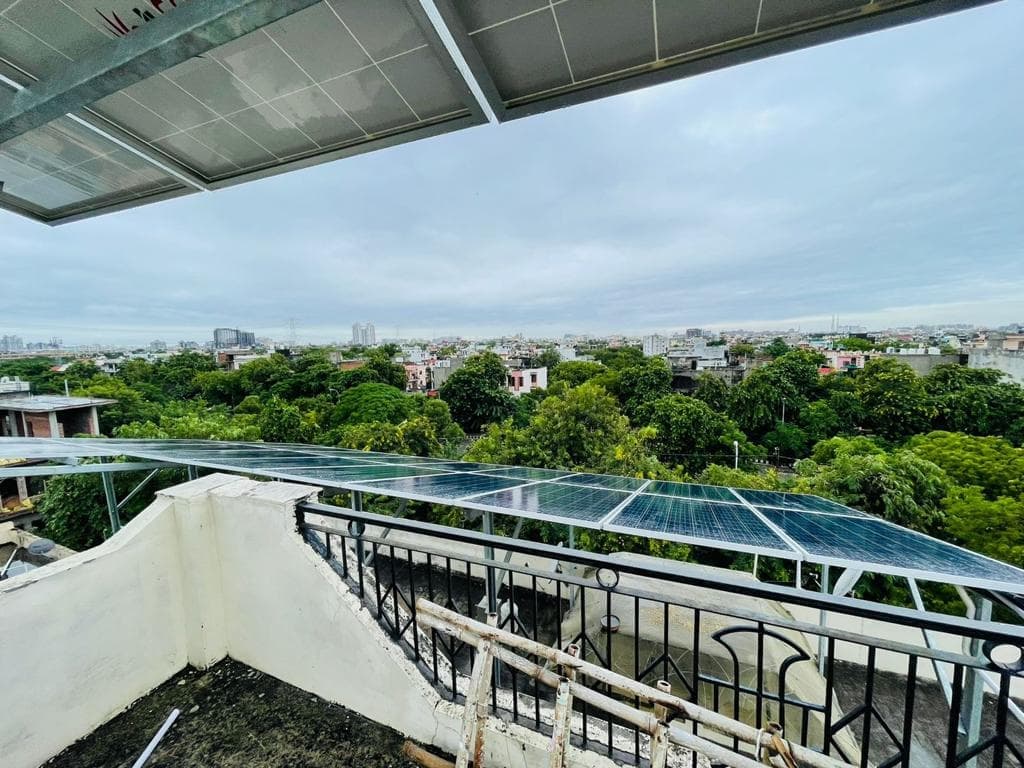
There is a published example from this side of the expressway. In April 2023 Verde Solaire installed a 10 kW plant on a Greater Noida rooftop and wrote at the time that the DISCOM fitted the net meter very quickly.
What the electricity bill does after solar
Uttar Pradesh urban domestic tariffs for FY 2026-27 are ₹5.50 (0–150 units), ₹6.00 (151–300), ₹6.50 (301–500) and ₹7.00 (above 500) per unit. In Greater Noida, NPCL charges the same slab rates as the state DISCOMs with a 10% regulatory discount.
Take a house using 400 units a month. Without solar it is billed through three slabs plus a fixed charge of ₹110 per kW per month on the sanctioned load. With a 3 kW system producing about 338 units a month, most of those units are netted off before they are billed, and what remains is the fixed charge, the small balance of units the system did not cover, and the taxes and duties this site does not model. The fixed charge is why the bill never reaches zero, and any page that promises a nil bill is skipping it. The bill calculator does the slab arithmetic for your own units and load.
The NPCL discount has two consequences. Your bill before solar is a little lower than a PVVNL customer's for the same consumption, and so is the saving after solar, so the payback is a few months longer in Greater Noida than in Noida city for an identical system. The calculator at the foot of this page uses the state slab rates, and therefore slightly overstates the saving for an NPCL consumer.
Paying for it: cash, loan or EMI
The PM Surya Ghar concessional loan is collateral-free, from nationalised banks, priced at repo rate plus 0.5 percentage points, which came to 5.75% on 28 July 2026, repaid over 10 years. Financing the whole 3 kW net price at that rate gives an equated monthly instalment (EMI) in the same region as the monthly saving, which is what the scheme was designed to do; the EMI calculator lets you test any rate and tenure. Verde Solaire has tie-ups with SIDBI, SBI and other NBFCs for collateral-free solar loans, and prepares the paperwork with you. The solar loan page carries the current terms.
Equipment and compliance
For a subsidised system, both the modules and the cells must be made in India, and from 1 June 2026 the cells must appear on the ALMM List-II, the Ministry of New and Renewable Energy's Approved List of Models and Manufacturers for cells. GST on a rooftop solar plant is about 8.9%: 5% on the panels and inverter (70% of the contract value) and 18% on the rest of the material and installation (30%). Verde Solaire's July 2025 post for Noida and Greater Noida describes three panel types, mono PERC, bifacial and TOPCon, with 25-year performance warranties on all three panel types. Its published home installations in Delhi, Noida and Varanasi used Adani and Vikram modules with KSolare inverters. Every quote names the make and model, so you can check them against the approved lists before you pay an advance; panels, inverters and batteries explains what those names mean. The scheme's official end date is 31 March 2027, so leave room inside it for the survey, the application and the inspection.
Where we have installed in Greater Noida
Verde Solaire's published service list for Greater Noida, from July 2025, names Pari Chowk, the Alpha, Beta, Delta, Gamma, Zeta and Omicron sectors, and societies and villas across Greater Noida West. An independent house in the lettered sectors is the simplest roof. A villa inside a gated society may need the society's consent for the roof and cable route; a flat in a tower is a housing-society project rather than an individual one. The installation page for Greater Noida describes the survey and what a roof needs to pass it.
The company is a registered PM Surya Ghar vendor in both Delhi and Uttar Pradesh, and offers a free site evaluation and no-obligation proposal.
The Greater Noida installation on the company's testimonials page is a 35 kW system at a college, installed in 2019. Mr. P. Sharma wrote that it "is working very well and has resulted in huge savings in electricity bill to the college". That project has its own page at Greater Noida college, 35 kW, and the rooftop pictured above at Greater Noida, 10 kW.
“We got a 35 KW solar energy system installed in 2019 at our Greater Noida college. This solar panel system is working very well and has resulted in huge savings in electricity bill to the college. Verde Solaire is one of the best solar power plant installation company in Noida and Greater Noida. We recommend them highly for installation of solar plant.”

Mr. P. Sharma 35 kW · Greater Noida
Questions people ask
Start with a clear plan for your savings
Get a free roof assessment and a written quote for branded equipment. We will also explain the loan, installation, net-metering and subsidy steps.