
2 kW solar system price with subsidy
A 2 kW system suits a smaller home using about 150 to 300 units a month.
The published price is ₹1,35,000 to ₹1,50,000. After the central subsidy and state top-up, the estimated amount is ₹45,000 to ₹60,000 in Noida and ₹23,000 to ₹38,000 in Delhi. Expect about about 225 units a month in Noida or about 218 units a month in Delhi.
See the figures for all five cities, what four panels can generate over a year and when 2 kW is a better fit than 1 kW or 3 kW.
| City | Price | Central subsidy | State subsidy | Net payable | Units a month |
|---|---|---|---|---|---|
| Noida | ₹1,35,000 – ₹1,50,000 | − ₹60,000 | − ₹30,000 | ₹45,000 – ₹60,000 | about 225 |
| Delhi | ₹1,35,000 – ₹1,50,000 | − ₹60,000 | − ₹52,000 + GBI | ₹23,000 – ₹38,000 | about 218 |
| Greater Noida | ₹1,35,000 – ₹1,50,000 | − ₹60,000 | − ₹30,000 | ₹45,000 – ₹60,000 | about 225 |
| Ghaziabad | ₹1,35,000 – ₹1,50,000 | − ₹60,000 | − ₹30,000 | ₹45,000 – ₹60,000 | about 225 |
Indicative prices. Your written quote, after a free site survey, is the final price. Delhi systems up to 3 kW also earn ₹3 per unit generated for five years (₹2 per unit for 3–10 kW). The UP state top-up is paid on top of the central subsidy; we confirm the current amount in your quote.
What the subsidy does to a 2 kW price
The central subsidy is ₹30,000 per kW for the first 2 kW, so a 2 kW system receives ₹60,000. The third kilowatt adds ₹18,000, and the total stops at ₹78,000 for any system of 3 kW or more. Remember that ₹78,000 is a cap, not a rate, and the scheme's “300 units” describes what a roughly 3 kW system can generate—not free units credited to your bill.
Uttar Pradesh adds ₹15,000 per kW, capped at ₹30,000 per consumer, on top of the central subsidy. A 2 kW system reaches that cap, so the state pays ₹30,000 in Noida, Greater Noida, Ghaziabad and Varanasi, and the combined subsidy of ₹90,000 covers about two-thirds of the published price.
Delhi's state subsidy is ₹26,000 per kW, capped at ₹78,000 (3 kW), which comes to ₹52,000 on 2 kW. Pages that still quote ₹2,000 per kW, maximum ₹10,000 (replaced in July 2025) are describing the old rate. Delhi also pays a generation-based incentive (GBI) of ₹3 per unit on home systems up to 3 kW, and ₹2 per unit on systems above 3 kW up to 10 kW, for 5 years from commissioning, paid monthly against the bill; any excess to the bank account. On 2 kW that is about ₹7,830 a year, or ₹39,150 over the five years.
How many units a 2 kW solar panel system produces
Verde Solaire's planning yield is 1,500 units per kW per year in Noida and 1,450 in Delhi. With a 10% derate for dust and monsoon, a 2 kW system produces about 225 units a month in Noida and the other Uttar Pradesh cities, and about 218 units a month in Delhi. Averaged over the year that is 7 to 8 units a day. April to June run higher, the monsoon months and December to January lower; the monsoon and dust page shows the seasonal shape.
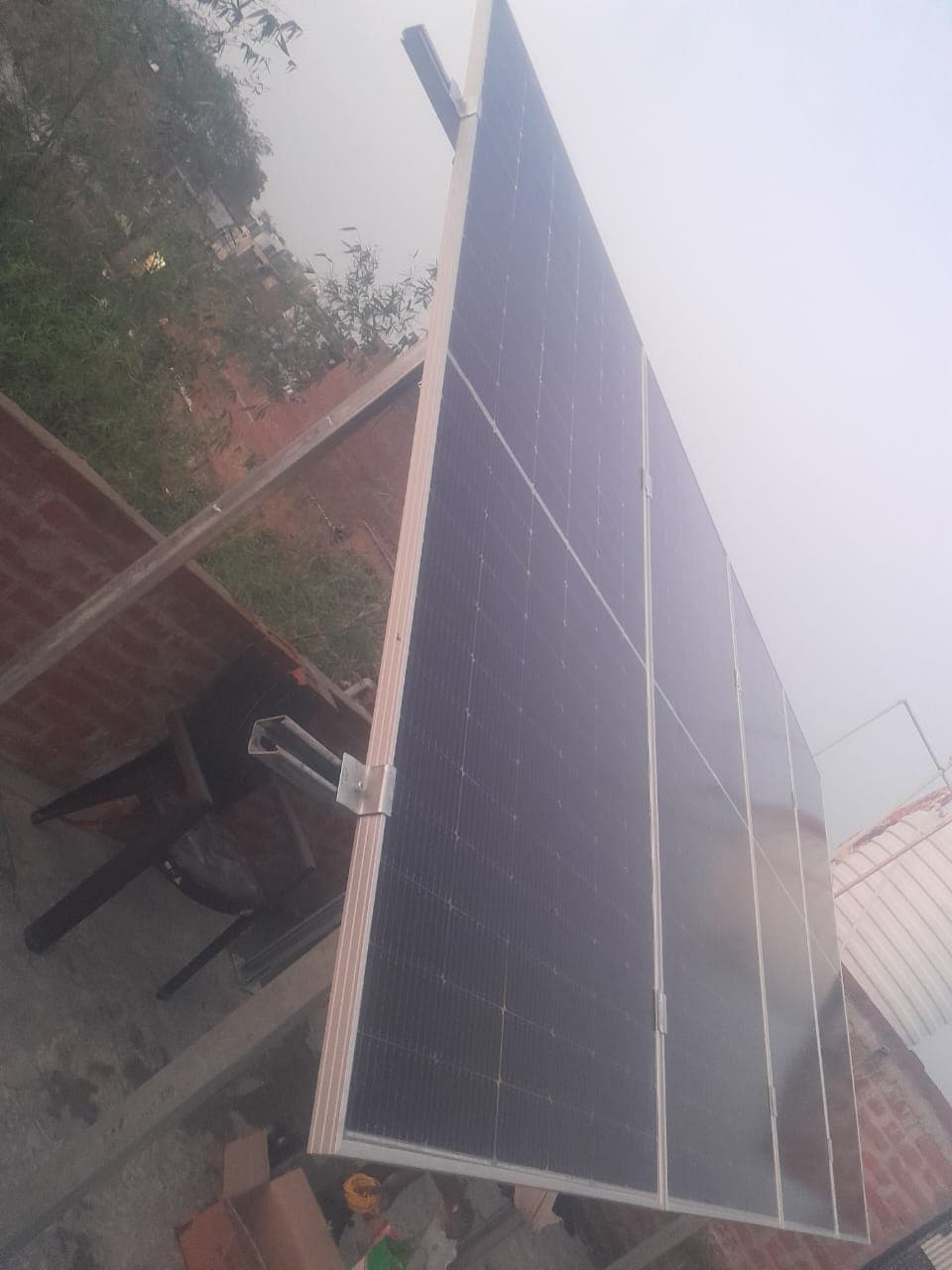
Four panels make up the system. Recent Verde Solaire installations used modules of 530 to 545 watt-peak (Wp), and at 540 Wp a 2 kW array is four panels needing about 200 to 233 square feet of shadow-free roof, scaled from the published 300 to 350 square feet for 3 kW. Four panels in one row is a small footprint, which is why 2 kW is often the size a builder floor with a shared roof can accommodate.
Who a 2 kW system suits
The official sizing guide is 0–150 units a month: 1–2 kW · 150–300 units: 2–3 kW · above 300 units: above 3 kW. Take twelve months of bills, add up the units and divide by twelve; a summer bill on its own will oversize the system. If the average lands between 150 and 300 units, 2 kW is the right size. In practice that is a flat or a small floor with fans, lights, a refrigerator, a washing machine and one air conditioner run for a few hours on summer evenings. A house that runs two or more air conditioners through May and June usually averages above 300 units and should read the 3 kW or 5 kW page. A home under 150 units, or a roof with room for only two panels, is a 1 kW case.
Two points apply only in Delhi. The free-power subsidy is worked out on net units, that is import minus export, so a home using 300 units with 2 kW of solar is billed on about 80 net units, inside the lowest slab of the DERC schedule. And households that averaged 400 units a month or less in FY 2025-26 are the stated audience of the zero-upfront scheme the Delhi Cabinet approved on 1 September 2026, which offers up to 3 kW at zero upfront cost, "subject to technical feasibility". If that describes you, read what is approved and what is notified before paying for a 2 kW system.
The system size calculator takes your monthly units and sanctioned load and returns the size; what size solar system do I need explains the reasoning behind it.
The step from 2 kW to 3 kW
The third kilowatt is the last one the subsidy pays for, so price it before settling on 2 kW. On the published list, moving from 2 kW to 3 kW adds ₹60,000 to ₹64,000 to the gross price. The central subsidy rises by ₹18,000, and in Delhi the state subsidy rises by another ₹26,000 to reach its ₹78,000 (3 kW) cap, so the net cost of the third kilowatt works out at about ₹16,000 to ₹20,000 in Delhi and ₹42,000 to ₹46,000 in Noida, where the state cap is already reached at 2 kW. For that you get roughly 110 more units a month on the same planning basis. Above 3 kW neither government adds anything, which is why 3 kW, not 4 kW, is the usual upgrade.
If your bills sit near the top of the 150 to 300 band, or you expect to add an air conditioner or an electric vehicle within a few years, 3 kW is usually the better buy. If they sit near the bottom, the extra kilowatt would mostly export rather than replace units you buy. In Delhi, credits roll over month to month, and any surplus left at the end of the financial year is paid at the DISCOM's average power purchase cost, rather than at your retail tariff. In that case 2 kW is enough. 3 kW vs 5 kW carries the same argument one step up.
Net metering for a 2 kW system
A 2 kW on-grid system needs a net meter and the electricity board's approval like any other size. In Delhi the Delhi Electricity Regulatory Commission (DERC) guidelines of July 2026 set a connection timeline of 10 days for systems up to 10 kW, with no application fee for domestic consumers, and since the 2024 amendment the DISCOM handles any load increase itself. In Uttar Pradesh, under the UPERC rooftop solar regulations of 2019, residential users may choose net or gross metering, and the DISCOM allows capacity within transformer limits. Noida city is served by PVVNL (Paschimanchal Vidyut Vitran Nigam Limited, a UPPCL company), while Greater Noida and Greater Noida West are served by NPCL (Noida Power Company Limited); the name on your bill decides which portal your application uses.
Verde Solaire is a registered PM Surya Ghar vendor in both Delhi and Uttar Pradesh, files the application on the national portal, attends the inspection and follows the meter through to activation. The net-metering guides cover each board, and installed but not activated covers a meter that stalls after commissioning.
Paying for a 2 kW system
At ₹45,000 to ₹60,000 net, many 2 kW customers pay cash. The full price is paid first and the subsidy is credited to your bank account after commissioning, officially "within 30 days" of the claim; about 15 days on average; who pays whom sets out the sequence. On the calculator's assumptions the net price in Noida is recovered in about three to four years.
If you would rather borrow, the PM Surya Ghar concessional loan is collateral-free, from nationalised banks, at repo rate plus 0.5 percentage points, which was 5.75% on 28 July 2026, over 10 years. A loan of ₹60,000 on those terms is an equated monthly instalment (EMI) of about ₹660 a month, less than the energy charge a 2 kW system removes from a Noida bill. Verde Solaire has tie-ups with SIDBI, SBI and other NBFCs for collateral-free solar loans. The EMI calculator takes any principal, rate and tenure, and the solar loan page lists the paperwork.
Equipment and compliance on a 2 kW system
For a subsidised system, both the modules and the cells must be made in India, and since 1 June 2026 the cells must also appear on the Approved List of Models and Manufacturers (ALMM) List-II. GST on a rooftop solar plant is about 8.9%: 5% on the panels and inverter (70% of the contract value) and 18% on the rest of the material and installation (30%), shown as a separate line on the quote. Verde Solaire's 2 kW system in Varanasi used Adani 540 Wp panels with a KSolare inverter, and its published price posts carry 25-year performance warranties on all three panel types.
Two searches around this size deserve a straight answer. A "2 kW solar inverter price" is not a separate purchase: the published range includes an on-grid inverter rated for the array, and the quote names it. A "2 kW solar battery price" belongs to a different system: an on-grid 2 kW system has no battery and stops during a power cut, so a home that wants backup needs a hybrid system, which is quoted per site because the battery drives the cost. Panels, inverters and batteries explain what the names on a quote mean.
What a 2 kW customer said
Rakhi Sharma had a 2 kW rooftop system installed under the subsidy scheme and wrote that "The staff of Verde Solaire was very cooperative and helpful. Their installation was top class and was as per their promise." More reviews, sorted by city, are on the reviews page, and the Varanasi installation pictured above is written up under projects.
The same 2 kW in each city
The city pages add the electricity board, the tariff that decides the saving, and local installation notes.
Noida
PVVNL
2 kW price by city
Delhi
BSES Rajdhani (BRPL) · BSES Yamuna (BYPL) · Tata Power-DDL
2 kW price by city
Greater Noida
NPCL
2 kW price by city
Ghaziabad
PVVNL
2 kW price by city
Questions people ask
Start with a clear plan for your savings
Get a free roof assessment and a written quote for branded equipment. We will also explain the loan, installation, net-metering and subsidy steps.