
Solar for housing societies and RWAs
A group housing society or resident welfare association (RWA) in Delhi or Uttar Pradesh gets a central subsidy of ₹18,000 per kW on a rooftop solar plant for its common facilities, up to 500 kW (3 kW per house), EV charging included. In Delhi the state adds ₹2,000 per kW, up to 500 kW and pays a generation-based incentive (GBI) of ₹2 per unit (up to 500 kW, 10 kW per house) for 5 years from commissioning, paid monthly against the bill; any excess to the bank account. Since 20 January 2026, the Seventh Amendment of 20 January 2026 opens virtual net metering to all Delhi consumers, with DISCOMs bearing line and network costs up to set caps, so flats without a roof of their own can share one plant on the society's terrace.
What the subsidy covers: common facilities, not flats
The PM Surya Ghar: Muft Bijli Yojana pays two kinds of subsidy. A household gets up to ₹78,000 on its own connection. A society gets ₹18,000 per kW on a plant connected to the meter that runs the lifts, pumps, corridor and campus lighting, the clubhouse and, as the rule says explicitly, EV charging. The rate is the one the scheme pays for the third kilowatt of a home, and the only ceiling is the capacity cap.
The cap is worked out per house: a society of 100 flats can claim on up to 300 kW, and the 500 kW ceiling is reached at 167 houses. The Delhi solar portal and the BSES Rajdhani FAQ both add a detail that surprises committees: the cap is inclusive of rooftop plants installed by individual residents.
The BSES FAQ also settles who can apply. Any consumer can take net metering, but the subsidy goes only to residential consumers and to society connections for common facilities. A flat owner with a separate meter is a residential consumer and can claim if there is a roof to install on. Where there is not, the same FAQ says installations under group and virtual net metering are eligible, which is where Delhi's 2026 amendment matters. Systems must use both the modules and the cells must be made in India, from 1 June 2026 the cells must appear on the ALMM List-II, and the installer must be a vendor registered on the national portal, and you choose the vendor on pmsuryaghar.gov.in. Verde Solaire is a registered PM Surya Ghar vendor in both Delhi and Uttar Pradesh.
Delhi adds a capital subsidy and a five-year incentive
Under the Delhi Solar Policy, in force from 14 March 2024 to 13 March 2027, a society receives ₹2,000 per kW, up to 500 kW for common facilities on top of the central amount. The GBI for societies is ₹2 per unit (up to 500 kW, 10 kW per house), paid for 5 years from commissioning, paid monthly against the bill; any excess to the bank account. On the company's published planning yield for Delhi of 1,450 units per kW a year, a 100 kW plant generates about 12,000 units a month, so the incentive is a meaningful line in the society's accounts. The electricity board adjusts it against the common-area bill first and pays any excess to the society's bank account each month.
Where to apply: subsidised systems: apply on the PM Surya Ghar portal and claim the Delhi subsidy and GBI on solar.delhi.gov.in; unsubsidised systems: the DISCOM portal. The zero-upfront scheme approved by the Delhi Cabinet on 1 September 2026 was described for households; nothing reported covers society common areas. The Delhi subsidy page tracks it.
Uttar Pradesh is simpler and less generous. The state subsidy of ₹15,000 per kW is capped at ₹30,000 per consumer, on top of the central subsidy, and the policy describes it as a residential subsidy per consumer. Uttar Pradesh has not published a subsidy for a society's common-area plant. A society in Noida, Greater Noida or Ghaziabad should plan on the central ₹18,000 per kW and the saving on its common-area bill, and treat any state money as a bonus if a notice appears.
Group and virtual net metering in Delhi
Ordinary net metering ties one plant to one meter, and a society, where the roof belongs to everyone and most consumption is inside the flats, rarely fits that shape. DERC's 2019 guidelines created two answers. Group net metering lets one consumer set the credit from a plant at one connection against its other connections in the same electricity board's area. Virtual net metering lets several consumers share one plant's output, each connection credited with an agreed proportion of the units. The Seventh Amendment of 20 January 2026 changed three things:
- Virtual net metering now applies to all consumers of Delhi, including consumers on a single point of supply.
- Participants may change the share of credit, or add connections to the arrangement, twice in a financial year with two months' notice.
- The electricity board bears the service-line and network-augmentation cost on the 11 kV and lower network, recovered through its aggregate revenue requirement, until cumulative virtual and group net-metering capacity reaches 110 MW for BSES Rajdhani, 100 MW for Tata Power-DDL, 30 MW for BSES Yamuna and 10 MW for NDMC.
The BSES FAQ's own example is two neighbours jointly applying under virtual net metering on a common roof, with the credit split in the proportion they decide; a society is the same arrangement with more parties.
Two other DERC rules shape a society plant. no feasibility study is needed up to 10 kW on the same supply type, and the DISCOM handles any load increase or transformer upgrade, so a common-area plant above 10 kW, which most are, still goes through a feasibility check, and the 2026 connection timeline above 10 kW is 25 days. Surplus is treated as it is for homes: credits roll over month to month, and any surplus left at the end of the financial year is paid at the DISCOM's average power purchase cost. The Delhi net-metering page lists the portal for each board.
In Uttar Pradesh, under the UPERC rooftop solar regulations of 2019, residential users may choose net or gross metering, and the DISCOM allows capacity within transformer limits. The state's regulations do not describe a virtual net-metering framework of Delhi's kind, so a Noida society's plant is designed around the common-facilities connection: it sits behind that meter and offsets that bill, and each flat's bill is untouched.
What the society resolution needs to cover
The application is made in the name of one connection and the subsidy is paid to one bank account, so the general body has to decide six things before a survey is worth doing:
- The connection. Which common-facilities connection the plant is registered on, and whether any flats join through virtual net metering. In Delhi the shares of credit, and the rule for changing them twice a year, belong in the participants' agreement.
- The roofs. Which terraces are used, who keeps access, and what happens to water tanks, mobile towers and the drying area. Disagreements over roof rights can stop a project before money is discussed.
- Capacity and phasing. The 3 kW per house cap, less any plants residents already have, and whether the society builds in one go or tower by tower.
- Money. Whether the cost comes from the corpus, a one-time contribution or a loan, and who signs the quote. The quote should show the gross price, each subsidy and the net figure on separate lines.
- The signatory and the bank account. Who operates the portal login and whose cancelled cheque goes in, because the subsidy arrives after commissioning, not before.
- Maintenance. Who cleans the panels, how the inverter is monitored and how a fault is reported; the maintenance and cleaning page explains what a service contract covers.
With those points minuted, the process is the standard one: a survey and load study of the common meters, a proposal naming the make and model of every component, the portal application, installation, the board's inspection and net meter, then the subsidy.
What we have built on shared buildings
Verde Solaire has not published a housing-society project. The closest published work is on institutional rooftops, which share what makes a society different from a home: one connection for a building used by many people, a committee as the customer, and a plant well above 10 kW.
Mr. P. Sharma, on a 35 kW college in Greater Noida installed in 2019, wrote that "this solar panel system is working very well and has resulted in huge savings in electricity bill to the college". Mr. Atul Singh, on a 20 kW school in Ayodhya, wrote that "the installation by Verde was very smooth and we have been able to reduce our electricity bill". The published list also includes 20 kW at the National Institute of Secondary Steel Technology in Punjab on CEL panels, 147 kW at C-MET Pune on a CPWD order and 170 kW for a Patna division won on tender. In August 2024 the company reported installing 350 kW across 29 schools and 3 colleges in one month for a West Bengal government programme, at 10 kW per school and 20 kW per college.
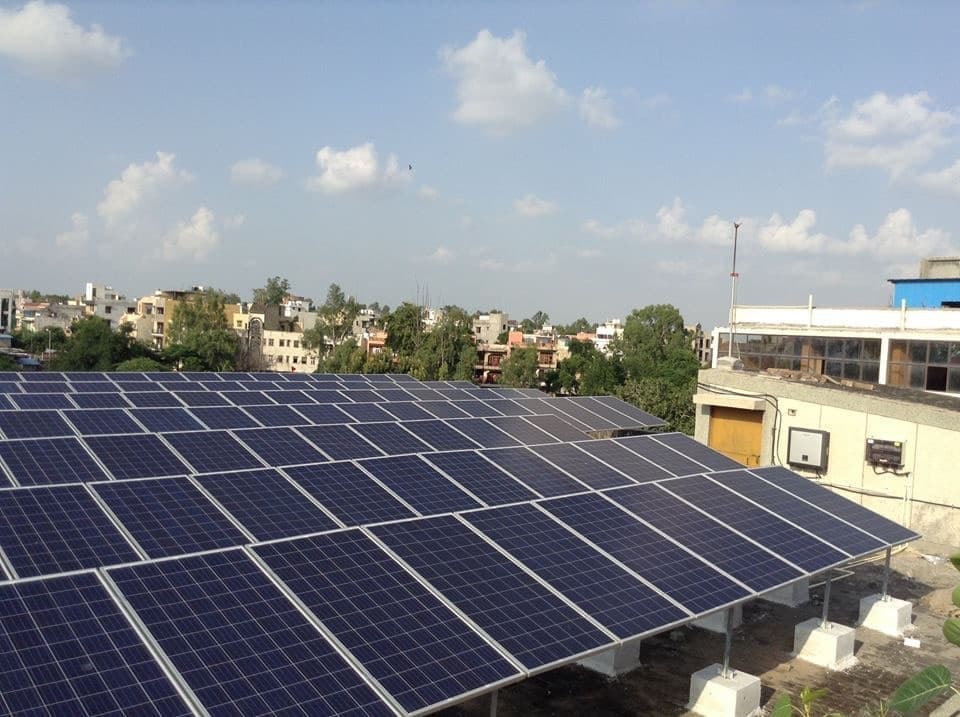
The company is ISO 9001:2015 certified and has delivered more than 50 MW of solar projects. The institutional work is described on the institutions page and the Greater Noida college project.
There is no published price for a society plant; the company's price list stops at 5 kW because structure, cabling and inverter choice on a 50 kW to 300 kW roof vary too much for a list price. The proposal follows a free site evaluation and no-obligation proposal. For the payback arithmetic on a common-area bill, use the commercial payback tool.
Commercial payback modelEnter the common-area bill, the roof area and the tariff to see the plant size, subsidy and payback for a society.Open the toolQuestions people ask
Start with a clear plan for your savings
Get a free roof assessment and a written quote for branded equipment. We will also explain the loan, installation, net-metering and subsidy steps.