
3 kW solar panel price in Delhi 2026
Choose 3 kW for a Delhi home using about 300 to 400 units a month. It is the size that receives the full central and Delhi state subsidy.
The published price is ₹1,99,000 to ₹2,10,000. After both subsidies, the estimated amount is ₹43,000 to ₹54,000, with a combined subsidy of ₹1,56,000. Delhi also pays ₹3 per unit for 5 years from commissioning, paid monthly against the bill; any excess to the bank account on the electricity your system generates.
For every Delhi capacity, see rooftop solar prices in Delhi. To compare 3 kW across cities, see the 3 kW page.
The price, and the two subsidies on top of it
| System | Price | Central subsidy | Delhi state subsidy | Net payable | Units a month |
|---|---|---|---|---|---|
| 2 kW | ₹1,35,000 – ₹1,50,000 | − ₹60,000 | − ₹52,000 | ₹23,000 – ₹38,000 | about 218 |
| 3 kW | ₹1,99,000 – ₹2,10,000 | − ₹78,000 | − ₹78,000 | ₹43,000 – ₹54,000 | about 326 |
| 5 kW | ₹3,25,000 – ₹3,50,000 | − ₹78,000 | − ₹78,000 | ₹1,69,000 – ₹1,94,000 | about 544 |
Indicative prices. Your written quote, after a free site survey, is the final price. Generation uses a planning yield with a 10% derate for dust and monsoon.
The published range covers panels, inverter, mounting structure, net metering, installation and warranty. The central subsidy is ₹30,000 per kW for the first 2 kW plus ₹18,000 for the third, and stops at ₹78,000. Delhi adds ₹26,000 per kW, capped at ₹78,000 (3 kW). The two are cumulative: the state amount is paid on top of the central one, not instead of it.
The table shows 2 kW and 5 kW alongside 3 kW for a reason. Below 3 kW you leave part of both subsidies unclaimed. Above 3 kW every extra kilowatt is paid in full, because neither subsidy grows past the third. That is why 3 kW is the size at which the subsidy covers the largest share of the price. If your consumption is well above 400 units a month, 3 kW against 5 kW works through the arithmetic and the 5 kW Delhi page has the figures.
The Delhi detail most quotes leave out: the per-unit incentive
Delhi's policy pays a generation-based incentive on top of the capital subsidy. For homes up to 3 kW it is ₹3 per unit; for homes above 3 kW and up to 10 kW it drops to ₹2 per unit. It runs for 5 years from commissioning, paid monthly against the bill; any excess to the bank account.
On the planning yield used across this site, a 3 kW system in Delhi earns ₹11,745 a year in GBI, or ₹58,725 over the five years. It is also the second reason 3 kW is the Delhi sweet spot: a 3.5 kW or 4 kW system gets no more subsidy and a lower incentive rate on every unit. The state subsidy and the GBI are claimed on the Delhi solar portal once the PM Surya Ghar application is through; the Delhi subsidy page lists the documents.
The central subsidy, Delhi capital subsidy and generation incentive are separate benefits. Your quote should show each one separately.
The roof
Verde Solaire's published figure for 3 kW is 300 to 350 square feet of shadow-free roof. On the 540 Wp modules this site uses for planning that is six panels, usually on an elevated structure so the roof underneath stays usable. Shadows from tanks, a lift room or a neighbour's upper floor matter most in winter, when the sun sits low, so the survey is a shadow analysis rather than a tape measure. One Chattarpur customer, K. K. Sharma, wrote that he "was highly impressed with their shadow analysis process". Verde Solaire offers a free site evaluation and no-obligation proposal.
On a builder floor the roof right decides whether you can install at all. Solar on builder floors and shared roofs covers the agreement you need from the other floors before anyone drills.
The panels
A subsidised system must use panels where both the modules and the cells must be made in India, and since 1 June 2026 the cells must also appear on ALMM List-II, the approved list of cell makers. GST on a rooftop solar plant is about 8.9%: 5% on the panels and inverter (70% of the contract value) and 18% on the rest of the material and installation (30%), and the quote should show it as its own line.
Verde Solaire's recent Delhi homes used Adani and Vikram modules of 530 to 545 Wp with KSolare inverters, including a 10 kW bifacial system in Greater Kailash and a 10 kW system in Janakpuri. The July 2025 price posts state 25-year performance warranties on all three panel types. Every written quote names the make, model and wattage; ALMM List-II explained shows how to check them.
Monthly units
On the planning yield this site uses for Delhi, 1,450 units per kW a year less a 10% allowance for dust and monsoon, a 3 kW system generates about 326 units a month. Verde Solaire's own June 2025 post for this size gave 360 to 400 units a month; the difference is the derate, applied so the estimate errs low. Generation is highest from March to June and lowest in the monsoon and in December and January, so the annual figure is the one to plan on; monsoon and dust in Delhi NCR has the month-by-month pattern.
The official sizing guide is 0–150 units a month: 1–2 kW · 150–300 units: 2–3 kW · above 300 units: above 3 kW. In practice a Delhi home averaging 250 to 400 units a month, with two to four air conditioners in summer, is the household for which 3 kW is the right answer, and the average of twelve bills, not the July bill, is the number to size from.
Sanctioned load
Your electricity bill shows a sanctioned load in kW, and two things depend on it. First, the fixed charge: Delhi bills ₹20 (up to 2 kW), ₹50 (2–5 kW), ₹100 (5–15 kW), ₹200 (15–25 kW) and ₹250 (above 25 kW) per kW per month of sanctioned load, so a 3 kW connection sits in the second band. Second, the rooftop capacity the electricity board will connect. Since the DERC amendment of July 2024, no feasibility study is needed up to 10 kW on the same supply type, and the DISCOM handles any load increase or transformer upgrade. If your connection is sanctioned at 2 kW and you want 3 kW of solar, the load increase is handled inside the same application rather than as a separate hurdle.
The electricity board process
Delhi has three distribution licensees, BSES Rajdhani, BSES Yamuna and Tata Power-DDL, plus the NDMC area, and the name printed on your bill tells you which one you deal with. Under the DERC guidelines of July 2026, PM Surya Ghar applicants apply through the national portal; everyone else through the DISCOM or state portal. There is no application fee for domestic systems up to 10 kW, and the guideline timeline for the connection is 10 days.
Verde Solaire is a registered PM Surya Ghar vendor in both Delhi and Uttar Pradesh. It files the portal application, attends the inspection and follows the meter through to activation. A Janakpuri homeowner, Navin Verma, wrote that "The installation of solar plant by Verde was of very good quality and their installation of solar system was also very quick", and added that the net-metering step was then delayed on the electricity board's side. A Greater Kailash customer, Jai Kumar Manghnani, wrote that the company "helped in applying for central subsidy for solar power plant". The Delhi net-metering guide sets out each stage with the board's own timelines, with separate pages for BSES Rajdhani, BSES Yamuna and Tata Power-DDL.
Once connected, credits roll over month to month, and any surplus left at the end of the financial year is paid at the DISCOM's average power purchase cost.
“I got a 10 KW solar system installed at my house in Janakpuri, New Delhi from Verde Solaire Pvt. Ltd. I used Vikram solar panels and KSolare inverters with an elevated module mounting structure. The installation of solar plant by Verde was of very good quality and their installation of solar system was also very quick. However the net metering process was delayed by the Discom and the electricity department has to look into this. I would recommend Verde to everyone who wants to install solar plant and save on their electricity bill.”

Navin Verma 10 kW · New Delhi
“I had installed solar plant from Verde (formerly Sirius Electric) more than five years back at my GK, New Delhi residence. This was a very good decision, as my electricity bill has been low since then. Verde (formerly Sirius) had used such good materials that the solar system has been working continuously without a single day breakdown since 2017. The solar plant installed at my place is maintenance free. I have recommended installation of solar system from Verde Solaire to many of my friends and neighbours in New Delhi NCR.”

Mr. S. C. Garg New Delhi
“Solar rooftop energy system of 10 KW was installed by Verde Solaire at my GK1, New Delhi residence. I am very happy with the professional services provided by the company. We had agreed for 530W Mono Perc Adani solar panels for my solar energy system, but they installed a better bifacial solar panel of Adani without charging anything extra from us. Verde Solaire in my opinion is one of the best solar plant installation company in Delhi NCR. The processes were simple and they have also helped in applying for central subsidy for solar power plant. This company is highly recommended by us for installation of solar power plant.”
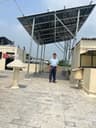
Mr. Jai Kumar Manghnani 10 kW · New Delhi
What the bill looks like afterwards
Delhi's domestic energy charges are still the DERC schedule for FY 2021-22, the last tariff order published: ₹3.00 (0–200 units), ₹4.50 (201–400), ₹6.50 (401–800), ₹7.00 (801–1,200) and ₹8.00 (above 1,200) per unit. On top come the fixed charge, a regulatory surcharge of 8% and a fuel surcharge that changes month to month. A 3 kW system generating about 326 units a month removes most of the energy charge of a home using 300 to 400 units; the fixed charge stays.
Delhi's free-power subsidy is 0–200 units a month free; 201–400 units at 50% off, capped at ₹800 a month; you must opt in. With solar it is worked out on net units, that is import minus export, so a home that imports 350 units and exports 200 has the subsidy worked out on 150 net units, inside the free band. The Delhi tariff explainer walks through the slabs, and the bill calculator does the arithmetic for your own units.
The zero-upfront scheme, and whether to wait
On 1 September 2026 the Delhi Cabinet approved a second amendment to the solar policy offering up to 3 kW at zero upfront cost, "subject to technical feasibility" to households that averaged 400 units a month or less in FY 2025-26. If your average is above 400 units, or you want more than 3 kW, the paid route on this page is the one that applies to you. Under 400 units, the scheme exists in a Cabinet decision and not yet at the portal.
What is approved and what is notified tracks the scheme as the rules appear.
Paying for it
The PM Surya Ghar concessional loan is collateral-free, from nationalised banks, priced at repo rate plus 0.5 percentage points, which was 5.75% on 28 July 2026, over 10 years. On the net price of a 3 kW system the EMI lands close to the monthly saving plus the GBI. Verde Solaire has tie-ups with SIDBI, SBI and other NBFCs for collateral-free solar loans and prepares the application with you; solar loans covers the banks and the EMI calculator takes any rate and tenure. The scheme's end date is 31 March 2027.
Questions people ask
Start with a clear plan for your savings
Get a free roof assessment and a written quote for branded equipment. We will also explain the loan, installation, net-metering and subsidy steps.