
5 kW solar panel price in Noida 2026
Choose 5 kW when your home uses around 400 to 600 units a month and you have room for ten panels. It produces about about 563 units a month a month on the planning yield used here.
The published Noida price is ₹3,25,000 to ₹3,50,000. After the central and Uttar Pradesh subsidy, the estimated amount is ₹2,17,000 to ₹2,42,000. The combined subsidy is ₹1,08,000, the same total available for 3 kW, so the extra capacity needs to suit your actual electricity use.
Read on for the PVVNL process and roof checks. The Noida price page compares every size, while the 5 kW page compares cities.
Where the money goes
| Line | Amount |
|---|---|
| Published price, July 2025 | ₹3,25,000 to ₹3,50,000 |
| Central subsidy, PM Surya Ghar | ₹78,000 |
| Uttar Pradesh subsidy | ₹30,000 |
| Net payable | ₹2,17,000 to ₹2,42,000 |
The published price covers panels, inverter, mounting structure, net metering, installation and warranty . GST on a rooftop solar plant is about 8.9%: 5% on the panels and inverter (70% of the contract value) and 18% on the rest of the material and installation (30%), shown as its own line on a written quote . You pay the installer the full price and the subsidy reaches your bank account after commissioning, so the net figure is what the system costs you, not what you hand over on the day. The extra 2 kW over a 3 kW system cost ₹1,26,000 to ₹1,40,000 on the published ranges, none of it subsidised.
The catch: the fourth and fifth kW are full price
The central subsidy is ₹30,000 per kW for the first 2 kW and ₹18,000 for the third, then it stops: ₹78,000 is the most any home receives, whether the system is 3 kW or 10 kW . Uttar Pradesh adds ₹15,000 per kW under its Solar Energy Policy 2022, capped at ₹30,000 per consumer, on top of the central subsidy, so the state top-up is already at its ceiling on a 2 kW system . Stack the two and every rupee of subsidy has been claimed by the third kilowatt. The fourth and fifth are bought at the installer's price.
That is not a reason to avoid 5 kW; it is a reason to size to your bills. The scheme's own guide is 0–150 units a month: 1–2 kW · 150–300 units: 2–3 kW · above 300 units: above 3 kW, and the number that matters is the twelve-month average, not the June peak. Between about 450 and 600 units a month, a 5 kW system displaces most of it and the two unsubsidised kilowatts still pay for themselves, only more slowly than the first three. Nearer 350, the 3 kW system in Noida is the better buy; 3 kW versus 5 kW works through the crossover.
Roof: what ten panels need
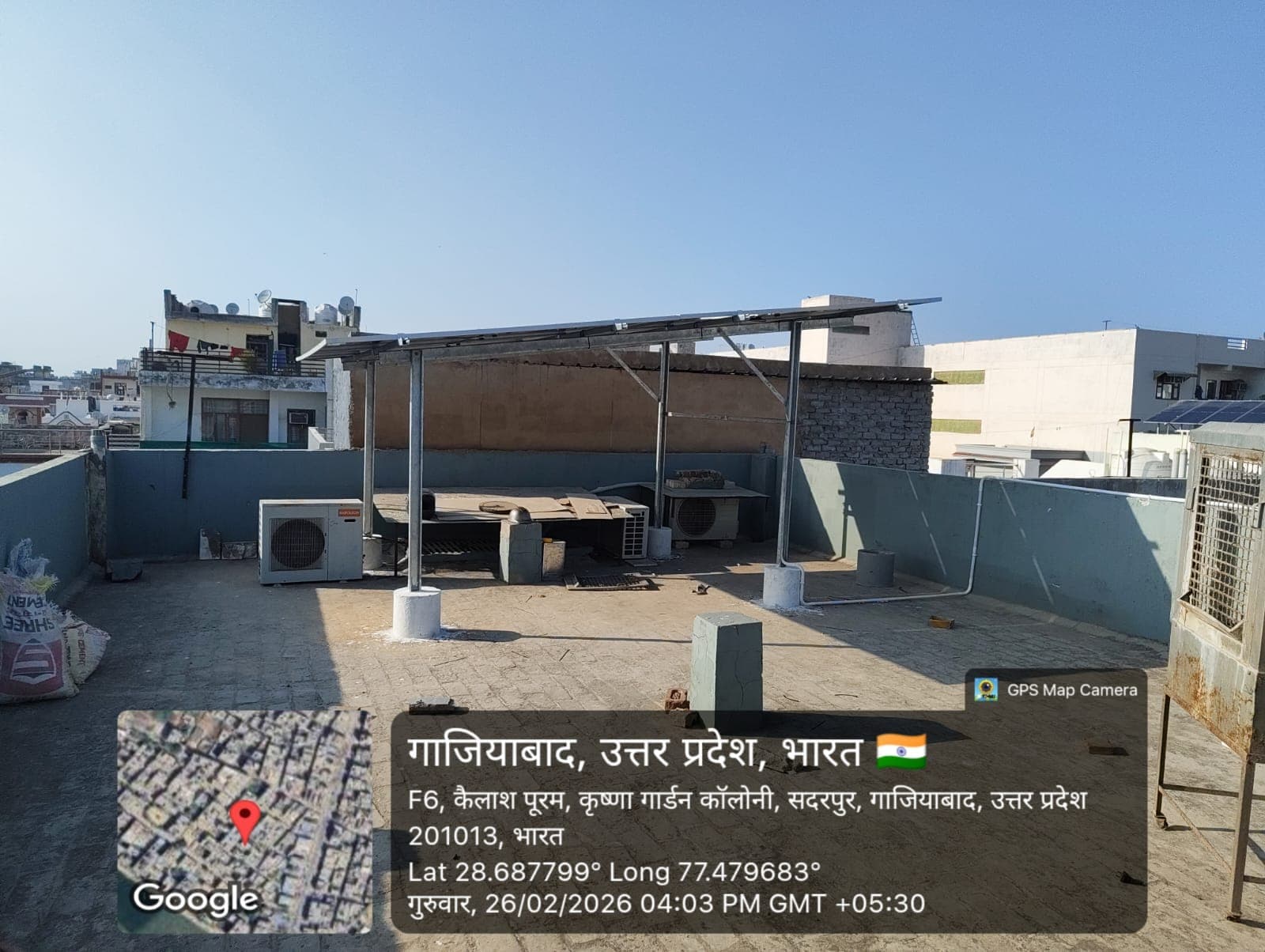
Recent Verde Solaire installations used modules of 530 to 545 Wp, so a 5 kW array is ten panels of around 540 Wp. Scaling the company's published 300 to 350 square feet for 3 kW , ten panels need about 500 to 580 square feet with no midday shadow from a water tank, parapet or the neighbour's upper floor. On a Noida builder floor the terrace is often shared, so the roof right matters as much as the area. Where the terrace must stay in use, the panels go on an elevated galvanised structure; it adds steel and labour, and the quote should state its height.
Panels and inverter
A subsidised system must use modules and cells made in India, and since 1 June 2026 the cells must be on the ALMM List-II . That rules out the cheapest imported modules. Verde Solaire's published home installations in Delhi, Noida and Varanasi used Adani and Vikram Solar modules with KSolare inverters, and the July 2025 price posts state 25-year performance warranties on all three panel types. Every quote names the make, model and wattage of panel and inverter; panels, inverters and batteries explains the names.
Monthly units and the bill
A 5 kW system in Noida generates about 563 units a month on the planning yield Verde Solaire uses for Noida, 1,500 units per kW a year, after a 10% allowance for dust and monsoon: more in April to June, less in the monsoon and the winter haze. Under net metering the units exported on a bright day are set against the units imported after dark on the same bill.
Uttar Pradesh urban domestic energy charges for FY 2026-27 are ₹5.50 (0–150 units), ₹6.00 (151–300), ₹6.50 (301–500) and ₹7.00 (above 500) per unit . A home using 600 units a month pays into the top slab; with a 5 kW system generating about 563 units a month, almost all of that energy charge disappears and the bill falls to the fixed charge plus the few dozen units the panels did not cover. The fixed charge stays, so the bill does not reach zero. The bill calculator works it out for your units and load.
Surplus goes to the grid at a regulator's rate, not your retail slab: the third amendment of the UPERC rooftop regulations set it at the weighted-average large-solar tariff plus 25% (Third Amendment, in force from July 2025) . A 5 kW system on a 350-unit home exports a lot at that rate, which is the arithmetic behind sizing to your own consumption.
Sanctioned load and the transformer
Two limits sit between a 5 kW quote and a 5 kW approval. The first is on your bill: the sanctioned load, the capacity your connection is contracted for, which also sets the fixed charge of ₹110 per kW per month . The second is on the street: under the UPERC rooftop solar regulations of 2019, residential users may choose net or gross metering, and the DISCOM allows capacity within transformer limits . A distribution transformer feeding a sector full of rooftop systems can run out of room, and when it does the board approves the capacity it can take rather than the capacity you asked for.
Neither limit shows on a price list, which is why the feasibility approval on the PM Surya Ghar portal comes before installation. Bring your latest bill to the free site evaluation: the sanctioned load on it and the transformer feeding your lane decide whether 5 kW is applied for as 5 kW or trimmed. Raising a low sanctioned load is a separate matter with PVVNL and lifts the fixed charge for as long as you hold the connection.
The PVVNL process, step by step
Noida city's electricity board is PVVNL (Paschimanchal Vidyut Vitran Nigam Limited, a UPPCL company); Greater Noida and Greater Noida West are on NPCL. The name on your bill confirms the right route. A subsidised 5 kW system takes the national route.
- Register on pmsuryaghar.gov.in with your state, electricity board, consumer number and mobile number, then apply for rooftop solar.
- Wait for PVVNL's feasibility approval, where the load and transformer checks happen.
- Have the system installed by a vendor registered on the portal; Verde Solaire is a registered PM Surya Ghar vendor in both Delhi and Uttar Pradesh.
- Submit the plant details and apply for the net meter; PVVNL inspects and the commissioning certificate is issued on the portal.
- Submit your bank details and a cancelled cheque; the subsidy is credited, officially "within 30 days" of the claim; about 15 days on average.
Verde Solaire files the application, attends the inspection and follows the meter through to activation; its July 2025 Noida price post gave 20 to 30 days after installation for net metering . Mr. L. R. Singh, a Noida customer with a 6 kW plant, wrote that he "was also able to get solar subsidy in record time because of the follow up of the team". The Noida net-metering page has the documents and the PVVNL specifics.
Paying for it
The PM Surya Ghar loan is collateral-free, from nationalised banks, priced at repo rate plus 0.5 percentage points, which came to 5.75% on 28 July 2026, over 10 years . On the middle of the 5 kW net range that is an EMI of about ₹2,500 a month, against a monthly saving of about ₹3,500 for a home using around 600 units at Noida's tariff. Both move with your usage, so run the EMI calculator with the quote in hand. Verde Solaire has tie-ups with SIDBI, SBI and other NBFCs for collateral-free solar loans and prepares the file. The scheme ends on 31 March 2027, and the subsidy is claimed after commissioning, so the system must be installed and inspected before then.
Keep your Noida 5 kW quote comparable
The value of a 5 kW system comes from reliable generation and the bill it can offset over time. Compare complete quotes: branded panel and inverter models, structure, wiring, warranty, net-metering support and a clear breakdown of the subsidy. Noida city is served by PVVNL, which determines the right portal for your application.
Questions people ask
Start with a clear plan for your savings
Get a free roof assessment and a written quote for branded equipment. We will also explain the loan, installation, net-metering and subsidy steps.